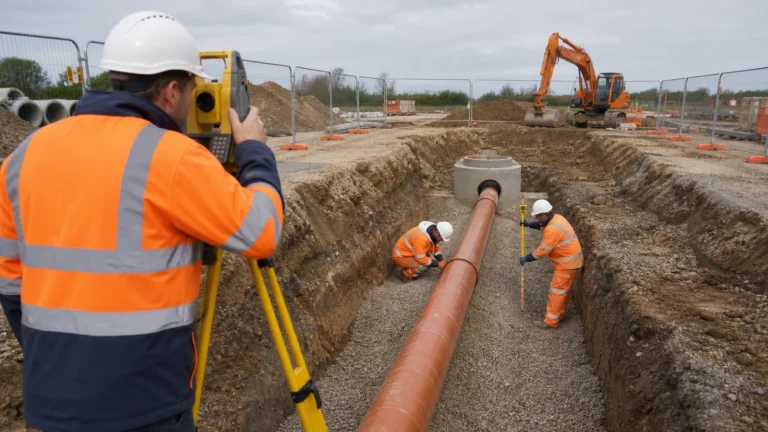
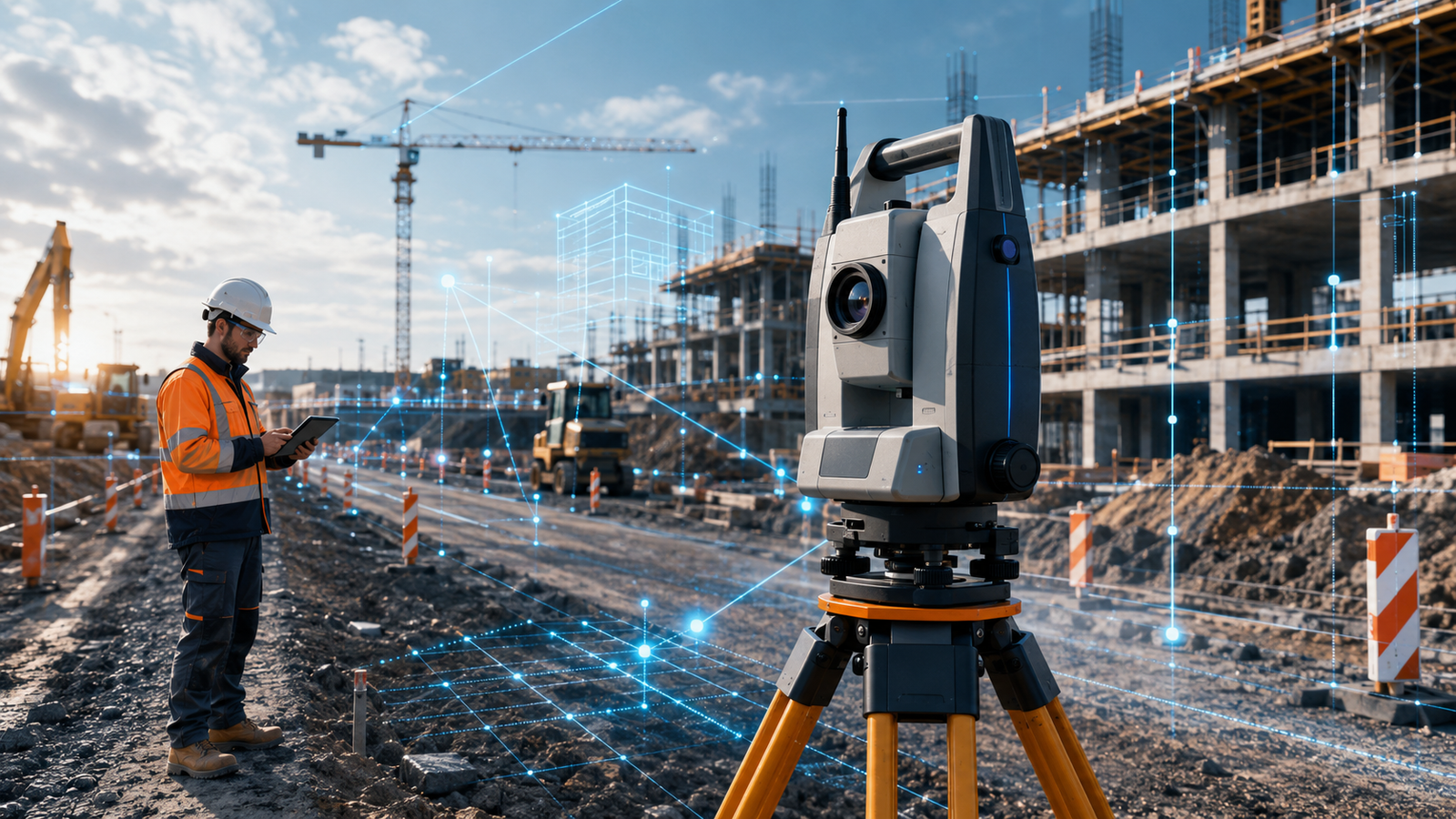
A total station is no longer just an angle-and-distance instrument. In 2026, the best total stations combine precision optics, electronic distance measurement, robotic tracking, GNSS integration, scanning, BIM workflows, cloud data transfer and field-to-office automation.
For surveyors, civil engineers, site engineers and contractors, the right choice depends less on buying the most expensive model and more on matching the instrument to the work: setting out kerbs, monitoring structural movement, surveying roads, controlling earthworks, measuring façades, scanning as-builts or managing machine-control data.
This guide reviews the strongest total station categories for 2026 and explains which type of instrument is best suited to each task and accuracy requirement.
At a Glance: Best Total Stations by Use Case
| Category | Recommended Type | Typical Accuracy | Best For |
|---|---|---|---|
| Best overall professional robotic total station | Leica TS16 / Trimble S Series / Topcon GT Series class | 1″–2″ | High-precision survey, construction control, infrastructure |
| Best for construction layout | Leica iCON / Trimble RTS / Topcon LN or GT construction range | 2″–5″ | Building gridlines, anchor bolts, MEP layout, concrete works |
| Best for roadworks and civil engineering | Topcon GT / Sokkia iX / Leica TS13–TS16 class | 1″–3″ | Roads, drainage, kerbs, utilities, earthworks |
| Best for one-person surveying | Robotic total station with active prism tracking | 1″–5″ | Topographic surveys, setting out, site engineering |
| Best for scanning and as-built capture | Trimble SX12 / Leica MS60 class | 1″ plus scanning capability | BIM verification, façades, complex structures |
| Best value manual total station | Topcon GM / Sokkia CX / Leica TS07 / GeoMax Zoom range | 2″–5″ | Small contractors, general setting out, local surveys |
| Best budget option | Manual 5″ total station from established serviceable brands | 5″ | Basic layout, small sites, training, occasional use |
How We Assessed the Best Total Stations
A total station should not be judged by brand reputation alone. For professional site work, the key selection factors are:
- Angular accuracy
Usually expressed in arc-seconds: 1″, 2″, 3″ or 5″. Smaller values mean higher precision. - Distance measurement accuracy
Typically expressed as ±(1 mm + 1.5 ppm), ±(2 mm + 2 ppm), or similar. This matters on long baselines and control work. - Robotic capability
Robotic instruments allow one-person operation, automatic target tracking and faster set-out workflows. - Reflectorless EDM range
Important for façades, inaccessible points, stockpiles, utilities and safety-critical measurements. - Tracking reliability
On busy sites, good prism lock, re-acquisition and active target recognition can save substantial time. - Software ecosystem
Compatibility with field controllers, CAD, LandXML, IFC, DXF, machine-control models and cloud platforms is often more important than the instrument alone. - Durability and service support
Calibration, repair centres, batteries, chargers, prisms, tribrachs and controller support directly affect lifecycle cost.
Best Total Stations in 2026
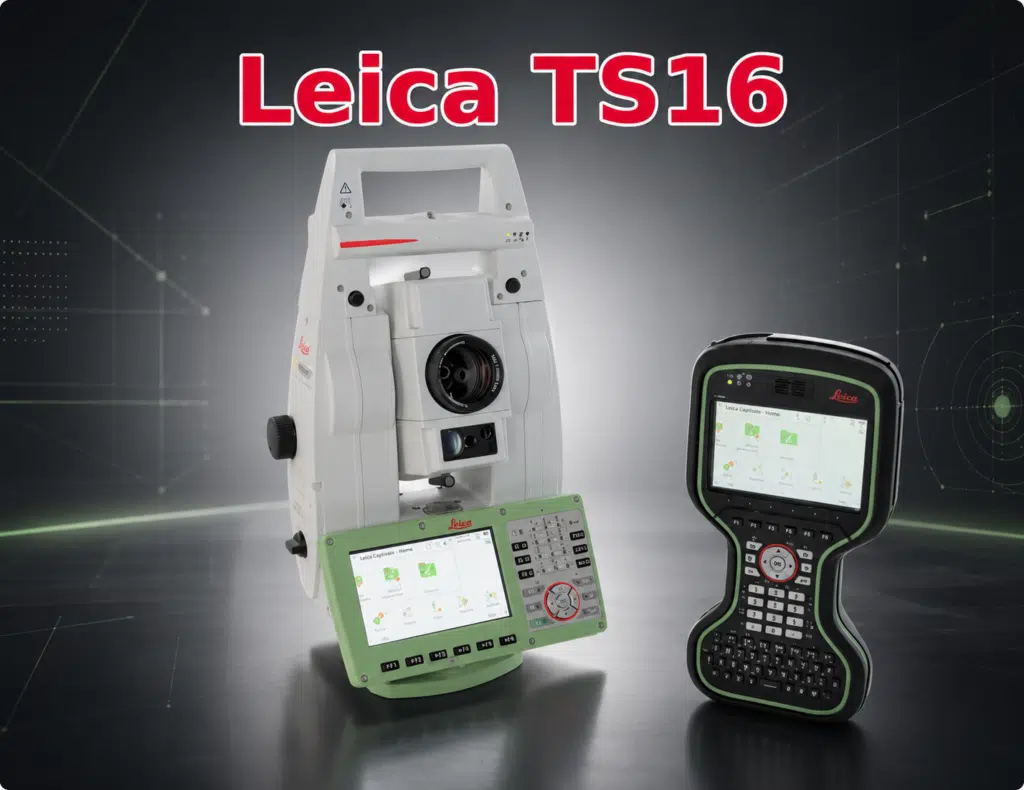
1. Leica TS16 — Best Overall Professional Robotic Total Station
The Leica TS16 remains one of the strongest choices for professional survey crews, civil engineering contractors and infrastructure projects. It is designed for high-accuracy robotic surveying and construction setting out, with excellent target recognition, automation and integration with Leica Captivate software.
Best for
The TS16 is ideal for roadworks, bridges, rail projects, building control, drainage networks, topographic surveys and precise construction setting out.
Why it stands out
Its strength is not just accuracy, but reliability. On a busy construction site, losing prism lock, struggling with resection routines or fighting poor field software costs time. The TS16 is designed for professional daily use where productivity matters.
Typical use cases
| Task | Suitability |
|---|---|
| Primary control networks | Excellent |
| Building gridlines | Excellent |
| Road alignment setting out | Excellent |
| Drainage and utilities | Excellent |
| Monitoring | Good to excellent, depending on setup |
| One-person operation | Excellent |
Accuracy guidance
For work requiring tight horizontal control, such as bridge bearings, bolt groups, steel frames or high-value structures, a 1″ or 2″ robotic instrument in this class is usually more appropriate than a 5″ construction total station.
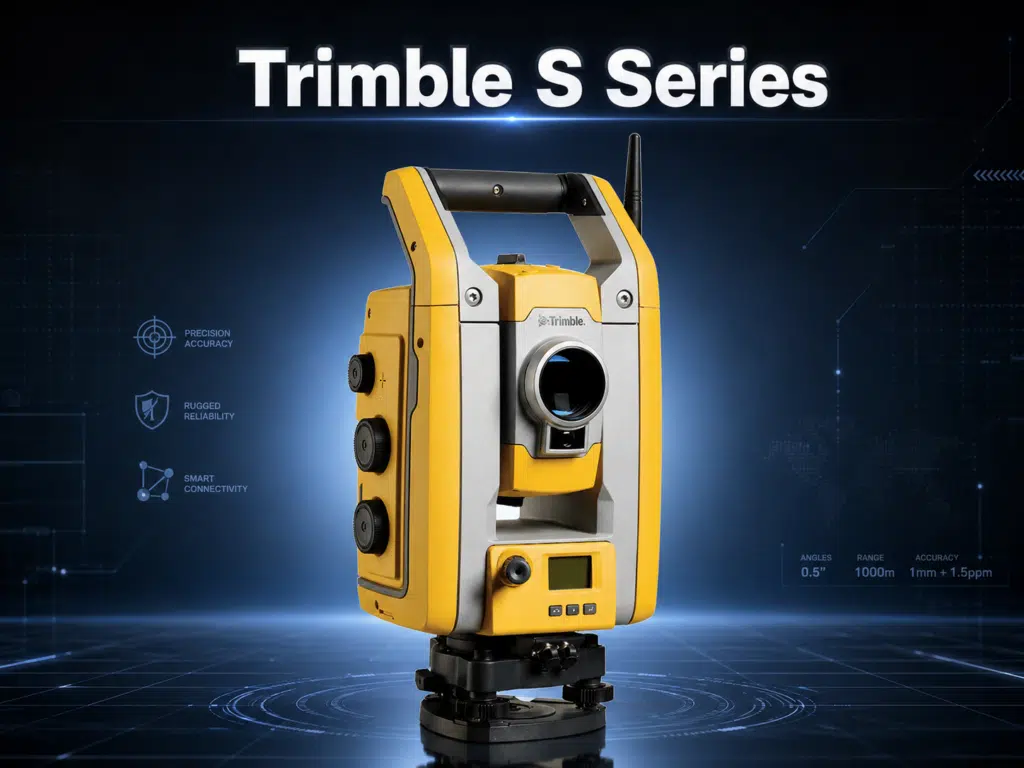
2. Trimble S Series — Best for Integrated Survey Workflows
Trimble robotic total stations are widely used by surveyors and contractors who need strong field-to-office connectivity. The Trimble S Series is particularly strong where total station work must integrate with GNSS, scanning, data collectors and office software.
Best for
Professional survey companies, civil contractors, road projects, utilities, land development and mixed GNSS/total station workflows.
Why it stands out
Trimble’s advantage is the workflow ecosystem. Where teams are already using Trimble Access, Business Center, GNSS receivers or machine-control systems, the total station becomes part of a wider production chain rather than a standalone instrument.
Typical use cases
| Task | Suitability |
|---|---|
| Topographic surveys | Excellent |
| Civil engineering setting out | Excellent |
| Integrated GNSS control | Excellent |
| Earthworks volume surveys | Excellent |
| Machine-control support | Excellent |
| Monitoring | Good, depending on model and software |
Accuracy guidance
For most professional construction and topographic work, a 2″ Trimble robotic instrument is a strong balance between precision, speed and cost. For very high-precision control or monitoring, move toward the higher-accuracy end of the range.
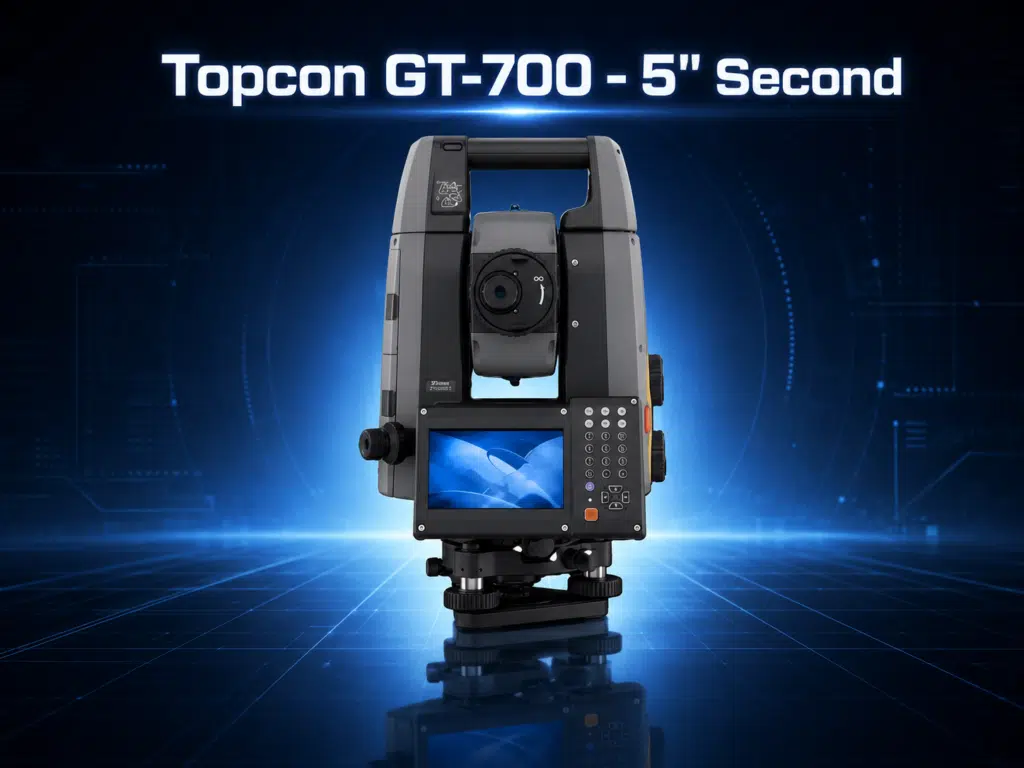
3. Topcon GT Series — Best for Civil Engineering and Site Engineering Crews
Topcon robotic total stations are popular with civil engineering contractors because they are fast, robust and well suited to roadworks, earthworks and site setting out.
Best for
Road construction, drainage, kerbs, utilities, housing infrastructure, earthworks, general civil engineering and contractor layout.
Why it stands out
The Topcon GT class is particularly well suited to site engineers who need rapid stakeout, reliable tracking and compatibility with construction workflows. It is a practical choice for teams working in demanding field conditions.
Typical use cases
| Task | Suitability |
|---|---|
| Road centreline and offsets | Excellent |
| Kerb lines and footways | Excellent |
| Drainage runs | Excellent |
| Earthworks and formation levels | Excellent |
| Building layout | Good to excellent |
| Fine structural monitoring | Model dependent |
Accuracy guidance
A 1″ or 2″ model is suitable for high-precision civil engineering control. A 3″ or 5″ model can be sufficient for general construction layout, drainage, kerbing and earthworks where tolerances are less severe.
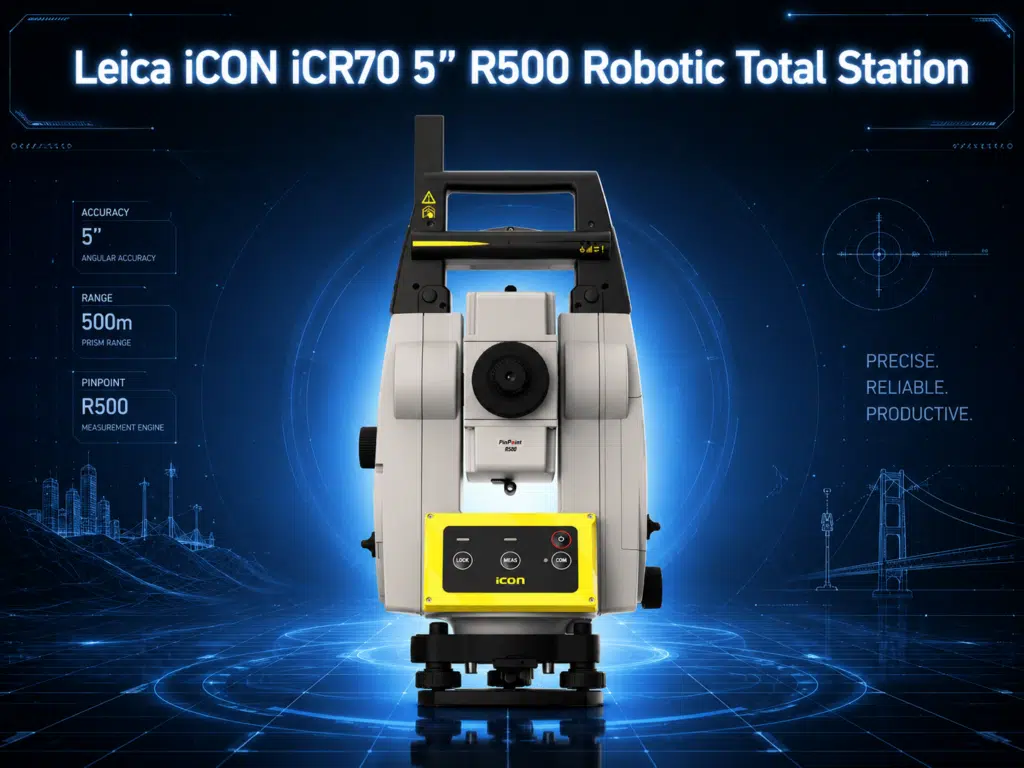
4. Leica iCON Robotic Total Stations — Best for Building Construction Layout
Leica iCON instruments are aimed heavily at construction users rather than traditional survey-only workflows. They are well suited to contractors setting out from digital models, drawings and BIM data.
Best for
Building contractors, concrete frames, steel frames, internal fit-out, façade layout, MEP penetrations, anchor bolts and gridline transfer.
Why it stands out
The iCON ecosystem is designed around construction layout. It is particularly useful where site teams work directly from models or coordinated design files.
Typical use cases
| Task | Suitability |
|---|---|
| Building grid setting out | Excellent |
| Anchor bolts | Excellent |
| MEP layout | Excellent |
| Concrete slab penetrations | Excellent |
| Façade points | Excellent |
| Traditional land survey | Good, but not always the main focus |
Accuracy guidance
For building construction, 2″–5″ instruments can be suitable depending on tolerances. For anchor bolts, steel baseplates, façade brackets and lift shafts, tighter control procedures and higher-accuracy instruments are recommended.
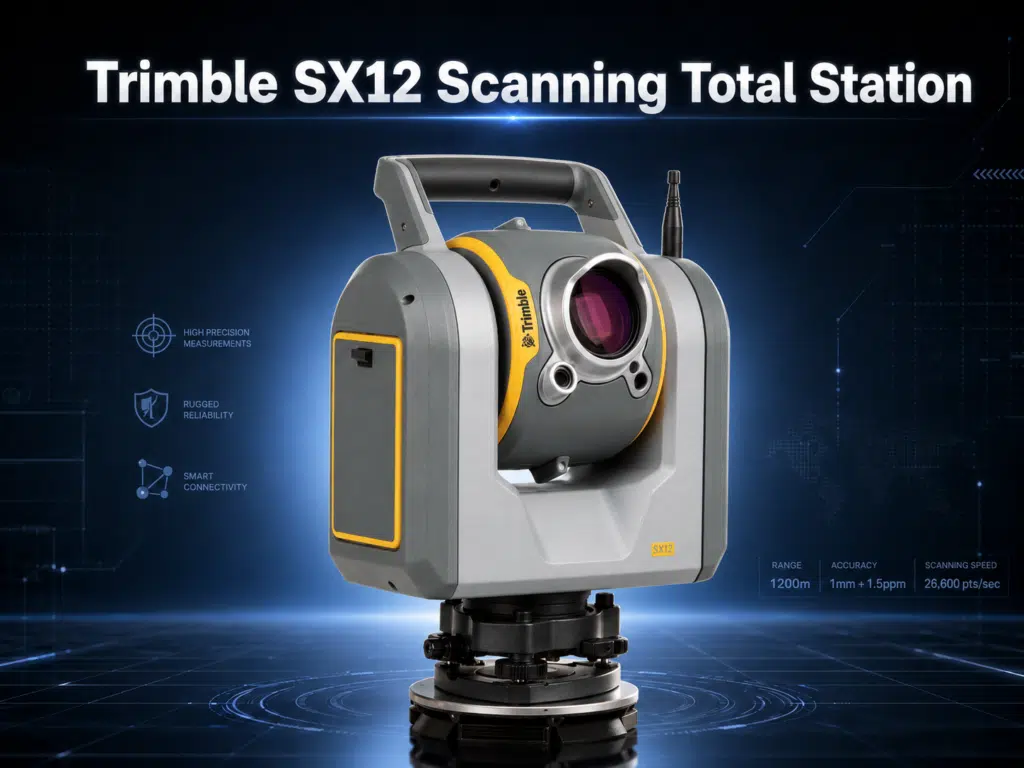
5. Trimble SX12 — Best for Total Station and Scanning Combined
The Trimble SX12 is a specialist instrument combining high-precision total station measurement with scanning capability. It is not the cheapest option, but it is highly valuable where survey, setting out and reality capture overlap.
Best for
As-built surveys, BIM verification, façades, complex structures, industrial sites, heritage work, deformation checks and projects where scanning reduces return visits.
Why it stands out
Instead of choosing between a total station and a laser scanner, instruments in this class allow teams to combine precise point measurement with dense spatial data capture.
Typical use cases
| Task | Suitability |
|---|---|
| As-built verification | Excellent |
| BIM comparison | Excellent |
| Façade surveys | Excellent |
| Complex plant rooms | Excellent |
| Standard setting out | Good |
| Low-budget construction layout | Not ideal |
Accuracy guidance
Scanning total stations are not always necessary for simple setting out. They become valuable when missing information is expensive: complex refurbishments, clashing services, façade tolerances, structural surveys or large as-built deliverables.
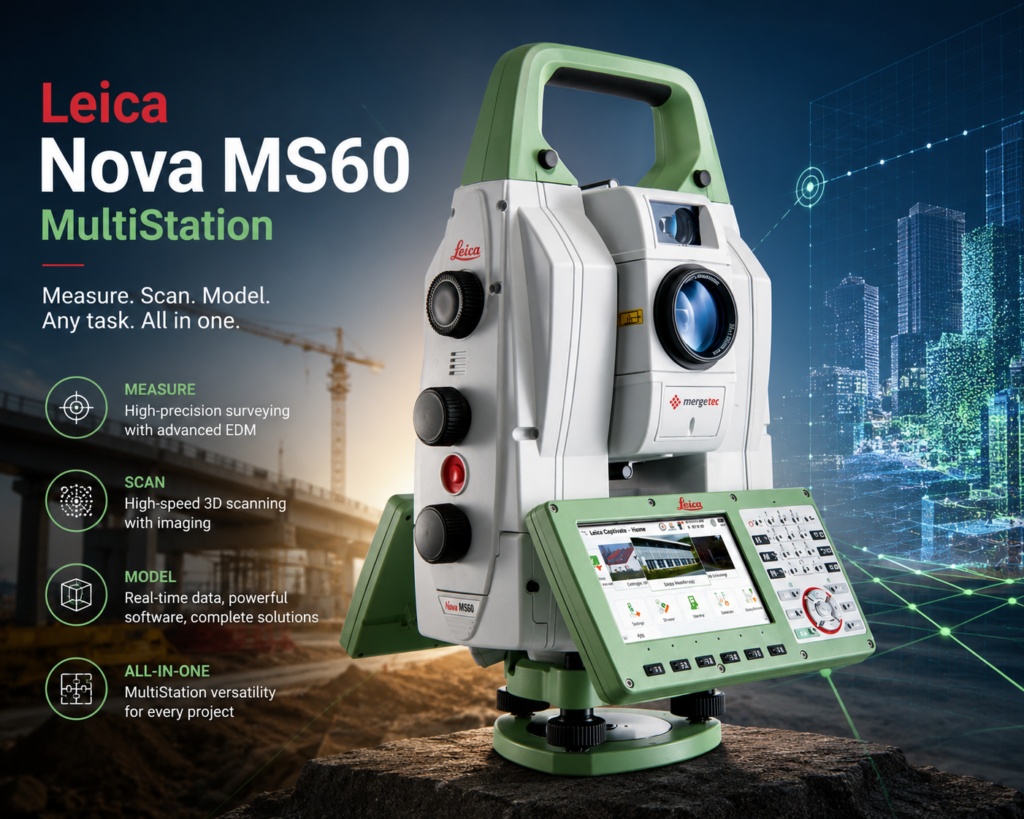
6. Leica Nova MS60 — Best High-End MultiStation
The Leica MS60 is a premium instrument combining total station accuracy, robotic operation and scanning capability. It is designed for high-end survey, engineering and monitoring applications.
Best for
Structural monitoring, bridges, tunnels, rail, industrial plants, deformation analysis, high-precision as-builts and advanced engineering surveys.
Why it stands out
The MS60 is not a general budget instrument. It is a specialist high-performance platform for teams that need precision measurement, automation and scanning in one instrument.
Typical use cases
| Task | Suitability |
|---|---|
| Structural monitoring | Excellent |
| Bridge surveys | Excellent |
| Tunnel works | Excellent |
| Industrial dimensional control | Excellent |
| High-precision as-built surveys | Excellent |
| Basic house setting out | Over-specified |
Accuracy guidance
For monitoring or deformation work, the instrument is only part of the solution. Stable control points, forced centring, temperature correction, observation methodology and repeatable setups matter as much as the total station itself.
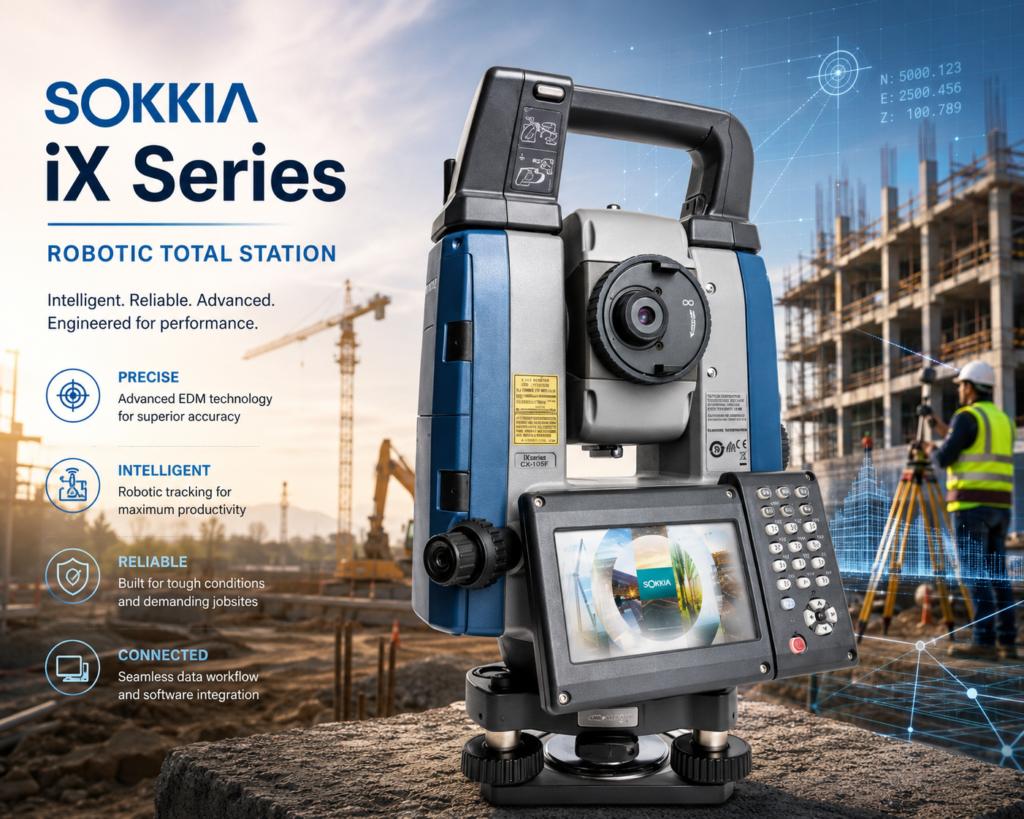
7. Sokkia iX Series — Best Practical Robotic Alternative
Sokkia robotic total stations offer a strong balance between professional capability and cost. They are often considered by contractors and survey companies looking for robust performance without moving to the most expensive premium packages.
Best for
General surveying, construction layout, civil engineering, roadworks, drainage and one-person crews.
Why it stands out
Sokkia instruments are known for practical site performance, and the iX range gives many of the benefits of robotic surveying at a competitive professional level.
Typical use cases
| Task | Suitability |
|---|---|
| One-person topographic survey | Excellent |
| Construction layout | Excellent |
| Road and drainage works | Excellent |
| Earthworks | Excellent |
| High-end scanning | Not the main purpose |
Accuracy guidance
A 2″ or 3″ robotic Sokkia is a strong option for contractors who need professional setting out accuracy but do not require integrated scanning.
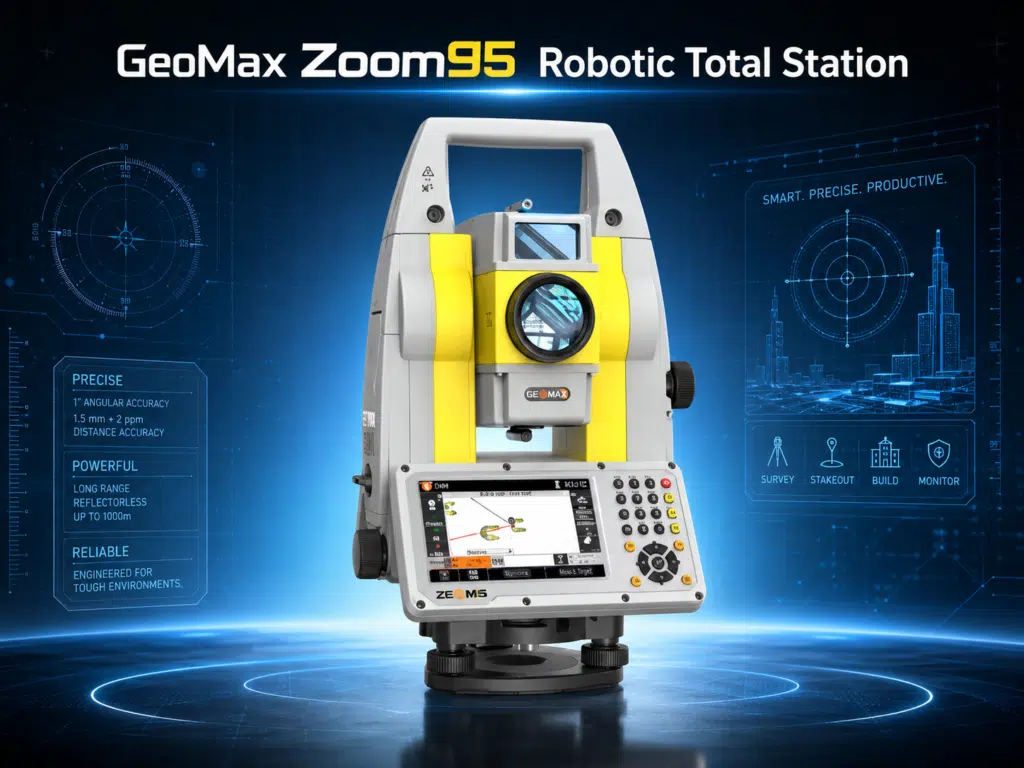
8. GeoMax Zoom Series — Best Value for Contractors
GeoMax total stations are often attractive to small and medium-sized contractors because they provide capable instruments at a more accessible price point than some premium alternatives.
Best for
Small contractors, site engineers, local survey work, housing projects, drainage, kerbs, utilities and general setting out.
Why it stands out
The main advantage is value. For many contractors, a reliable 2″–5″ total station with good software and service support is more useful than a high-end robotic instrument that exceeds the project requirements.
Typical use cases
| Task | Suitability |
|---|---|
| Housing estate setting out | Good to excellent |
| Drainage and utilities | Good to excellent |
| Kerbs and external works | Good |
| Small topographic surveys | Good |
| High-precision monitoring | Not ideal |
Accuracy guidance
For general site engineering, a 5″ instrument may be adequate. For tighter building layouts or longer sight distances, a 2″ model is a safer choice.
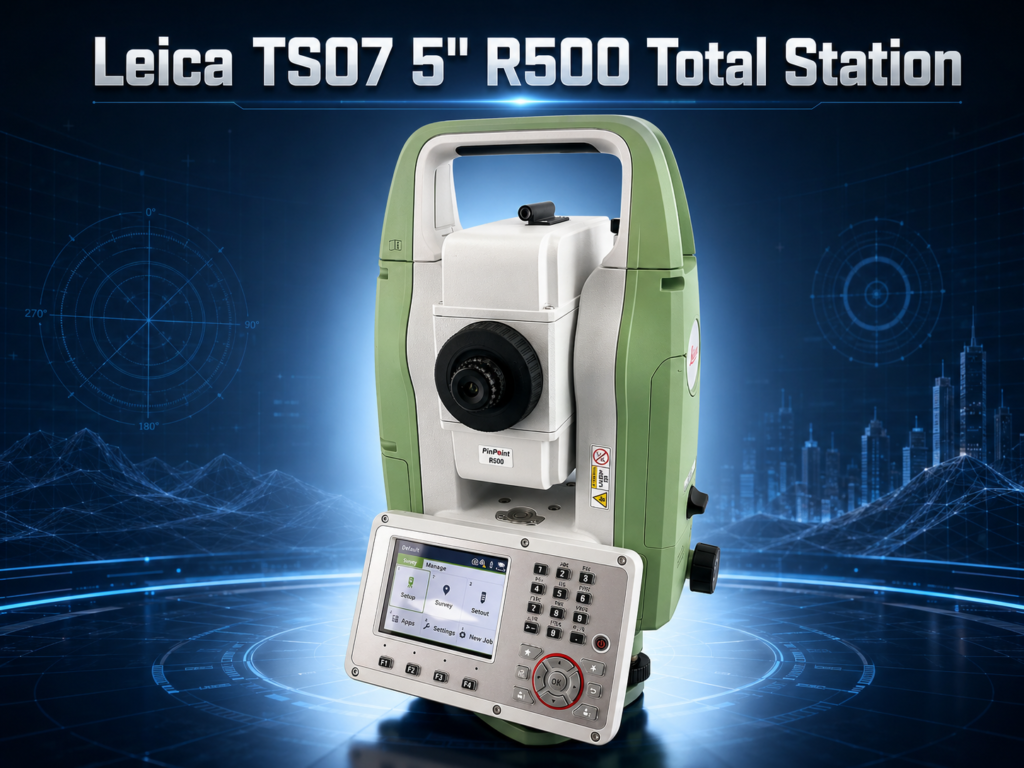
9. Leica TS07 — Best Manual Total Station for Professional Contractors
The Leica TS07 is a strong manual total station option for contractors who do not require robotic operation but still want professional quality, reliable measurement and a mature software environment.
Best for
Small construction firms, site engineers, general setting out, local authority works, housing plots, drainage and external works.
Why it stands out
Manual total stations are slower than robotic instruments, especially when used by two-person crews, but they remain cost-effective and reliable for many projects.
Typical use cases
| Task | Suitability |
|---|---|
| Small site setting out | Excellent |
| Drainage runs | Excellent |
| Kerb lines | Excellent |
| Boundary checks | Good |
| One-person layout | Limited |
| High-volume production setting out | Less efficient than robotic |
Accuracy guidance
A 2″ TS07 is suitable for more demanding layout work. A 5″ model is typically acceptable for general construction tasks where tolerances are moderate and sight distances are controlled.
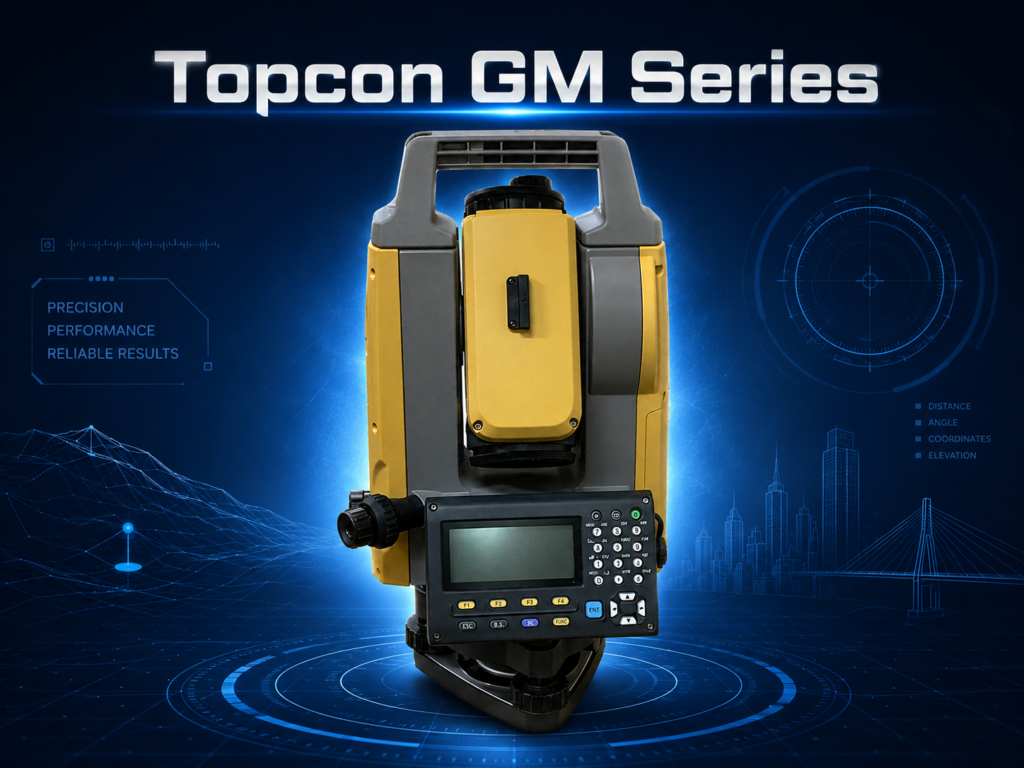
10. Topcon GM Series — Best Budget Professional Manual Total Station
The Topcon GM series is a practical manual total station range for contractors, engineers and surveyors who need dependable performance without the cost of robotics.
Best for
General construction layout, small civils projects, drainage, earthworks, kerbs, training, small topographic surveys and occasional survey work.
Why it stands out
It provides a sensible balance between cost, accuracy and durability. For many smaller contractors, this type of instrument is more realistic than a premium robotic total station.
Typical use cases
| Task | Suitability |
|---|---|
| Basic setting out | Excellent |
| Drainage and manholes | Good |
| Kerb and footway works | Good |
| Small topo surveys | Good |
| High-speed one-person work | Not ideal |
| Precision monitoring | Not ideal |
Accuracy guidance
A 5″ manual total station is usually acceptable for basic setting out, but for longer distances or tighter tolerances, 2″ or 3″ is preferable.
Understanding Total Station Accuracy
The angular accuracy of a total station is commonly expressed in seconds of arc. This affects the lateral error as distance increases.
Approximate lateral error from angular accuracy:
| Sight Distance | 1″ Instrument | 2″ Instrument | 5″ Instrument |
|---|---|---|---|
| 50 m | ±0.2 mm | ±0.5 mm | ±1.2 mm |
| 100 m | ±0.5 mm | ±1.0 mm | ±2.4 mm |
| 200 m | ±1.0 mm | ±1.9 mm | ±4.8 mm |
| 500 m | ±2.4 mm | ±4.8 mm | ±12.1 mm |
These figures only show angular contribution. Real site accuracy also depends on EDM accuracy, centring error, prism constant, atmospheric correction, control quality, tripod stability, operator method and resection geometry.
Which Total Station Should You Use by Task?
1. Topographic Surveys
For topographic surveys, speed and data management are usually more important than ultra-high angular precision.
Recommended instrument
A 2″–5″ robotic total station or a manual total station for smaller sites.
Best features
Look for reflectorless measurement, good coding, linework capability, fast data export and compatibility with CAD or survey software.
Suitable choices
Trimble S Series, Leica TS13/TS16, Topcon GT, Sokkia iX, GeoMax Zoom, Leica TS07 or Topcon GM.
2. Construction Setting Out
Construction layout requires repeatability, speed and clear workflows. The required accuracy depends on the element being set out.
| Work Type | Recommended Accuracy |
|---|---|
| Earthworks profiles | 5″ usually acceptable |
| Kerbs and footways | 3″–5″ |
| Drainage lines | 2″–5″ |
| Building gridlines | 1″–3″ |
| Anchor bolts and baseplates | 1″–2″ |
| Lift shafts and structural cores | 1″–2″ with strict control procedures |
Recommended instrument
For high-volume construction layout, a robotic total station is usually the best choice. For small sites, a manual total station remains cost-effective.
Best features
Robotic tracking, stakeout software, CAD import, DXF support, active prism tracking and simple field workflows.
3. Roadworks and Infrastructure
Road projects require strong alignment handling, chainage-offset workflows, surface models and reliable field performance.
Recommended instrument
A 1″–3″ robotic total station for main control and detailed setting out. A 3″–5″ instrument can be used for general road furniture, kerbs and lower-tolerance elements.
Best features
Road alignment software, LandXML support, prism tracking, long battery life, rugged design and compatibility with GNSS or machine-control systems.
Suitable choices
Topcon GT Series, Leica TS16, Trimble S Series, Sokkia iX.
4. Drainage, Utilities and External Works
Drainage requires reliable horizontal and vertical control. In many cases, level control is better managed using a digital level or laser level in combination with the total station.
Recommended instrument
A 2″–5″ total station is generally suitable, depending on pipe runs, gradients and tolerance requirements.
Best features
Good stakeout functions, reflectorless measurement, robust tripod setup, easy coordinate upload and reliable control checks.
Practical note
For shallow gradients, small vertical errors can become significant. Always check invert levels independently and avoid relying on one setup without verification.
5. Structural Monitoring
Monitoring is one of the most demanding applications. Instrument accuracy alone is not enough.
Recommended instrument
A 0.5″–1″ high-precision robotic total station or monitoring-capable MultiStation.
Best features
Automated monitoring software, stable forced-centred control points, high-quality prisms, temperature and pressure corrections, repeatable observation cycles and deformation reporting.
Suitable choices
Leica MS60, Leica TS16 monitoring configuration, Trimble high-precision robotic systems.
Practical note
For monitoring, methodology is critical. Poor control point stability can make an expensive instrument produce misleading results.
6. BIM, As-Built Surveys and Façade Verification
For as-built capture, point density matters. A standard total station can measure discrete points, but scanning-capable instruments can capture full surfaces.
Recommended instrument
A scanning total station or MultiStation.
Best features
Scanning, imaging, point cloud export, BIM comparison, CAD integration and strong office processing software.
Suitable choices
Trimble SX12, Leica MS60.
Practical note
Scanning total stations are excellent when the deliverable requires more than isolated points: façades, steel frames, plant rooms, heritage structures and complex refurbishments.
7. Earthworks and Volume Surveys
For earthworks, speed and surface modelling are usually more important than very high angular accuracy.
Recommended instrument
A robotic total station, GNSS rover or combined GNSS/total station workflow.
Best features
Surface model support, LandXML import/export, fast topo coding, machine-control compatibility and cloud transfer.
Accuracy guidance
For bulk earthworks, 5″ may be adequate. For formation trimming, road layers or tie-ins to hard construction, tighter control is required.
Manual vs Robotic Total Station
Manual Total Station
A manual total station is suitable where budgets are limited, work volume is moderate and two-person operation is acceptable.
Advantages
Lower purchase cost, simple operation, lower maintenance cost and good reliability.
Limitations
Slower setting out, usually needs two people, less efficient on large sites and less suitable for high-volume layout.
Robotic Total Station
A robotic total station allows one-person operation and automatic target tracking.
Advantages
Faster layout, reduced labour, better productivity, one-person operation and improved workflow automation.
Limitations
Higher purchase cost, more complex setup, greater dependence on batteries, controllers and software.
What Accuracy Do You Really Need?
Buying a 1″ total station for every job is not always necessary. The right approach is to match instrument accuracy to the tolerance of the work.
| Application | Suggested Instrument Class |
|---|---|
| Basic site layout | 5″ |
| Small building works | 3″–5″ |
| Drainage and utilities | 2″–5″ |
| Roadworks | 2″–3″ |
| Building grids | 1″–3″ |
| Steel frame and anchor bolts | 1″–2″ |
| Bridge works | 1″–2″ |
| Monitoring | 0.5″–1″ |
| Industrial dimensional control | 0.5″–1″ |
| BIM/as-built scanning | Scanning total station |
The key principle is simple: the instrument should be more accurate than the tolerance you need to achieve, but the control network and field procedure must be at the same standard.
Common Mistakes When Choosing a Total Station
1. Choosing by angular accuracy only
A 1″ total station used on unstable control with a poor tripod setup will not deliver 1″ results. Control quality, centring and observation method matter.
2. Ignoring software compatibility
An excellent instrument with poor data exchange can slow down the entire project. Check support for DXF, LandXML, CSV, IFC or your preferred survey platform.
3. Buying robotic when the workflow does not need it
Robotic instruments are powerful, but smaller teams doing occasional layout may get better value from a high-quality manual instrument.
4. Buying too cheaply
Very low-cost instruments may look attractive, but calibration, spares, batteries, service support and software limitations can make them expensive over time.
5. Overlooking calibration and maintenance
A total station used for professional setting out should be checked regularly, especially after transport, impact, long storage or exposure to harsh site conditions.
Recommended Buying Strategy for 2026
For small contractors
Choose a reliable 2″–5″ manual total station from a serviceable brand. Prioritise durability, calibration support and simple data transfer.
Good fit: Topcon GM, Leica TS07, GeoMax Zoom manual models.
For site engineers
Choose a 2″–3″ robotic total station if you do regular setting out. It will save labour and increase productivity.
Good fit: Leica TS16, Topcon GT, Sokkia iX, Trimble S Series.
For building contractors
Choose a construction-focused robotic total station with strong layout software and CAD/BIM compatibility.
Good fit: Leica iCON, Trimble RTS/S Series construction workflows, Topcon construction layout systems.
For survey companies
Choose a robotic total station that integrates well with GNSS, coding, office processing and deliverable production.
Good fit: Trimble S Series, Leica TS16, Topcon GT, Sokkia iX.
For monitoring and high-precision engineering
Choose a high-precision robotic total station or MultiStation with monitoring software and stable prism systems.
Good fit: Leica MS60, Leica TS16 monitoring configurations, Trimble high-precision systems.
For BIM and complex as-built work
Choose a scanning-capable total station or combine a robotic total station with a dedicated scanner.
Good fit: Trimble SX12, Leica MS60.
Final Verdict: The Best Total Station Is Task-Dependent
There is no single “best total station” for every surveyor, contractor or engineer in 2026.
For premium professional survey and engineering work, instruments such as the Leica TS16, Trimble S Series and Topcon GT Series remain strong choices. For construction layout, Leica iCON and Trimble construction workflows are particularly efficient. For scanning and BIM verification, the Trimble SX12 and Leica MS60 sit in a more advanced category. For smaller contractors, manual instruments such as the Leica TS07, Topcon GM and GeoMax Zoom range can offer excellent value.
The most important decision is not the brand name. It is matching the total station to the required task, tolerance, workflow and site environment. A well-chosen 3″ or 5″ instrument used correctly can outperform a premium 1″ instrument used with poor control, weak procedures or incompatible software.
For professional site engineering, the best total station is the one that gives repeatable results, integrates with your workflow, can be serviced locally and meets the accuracy requirements of the work without unnecessary cost.
Conclusion: Choosing the Best Total Station in 2026
Choosing from the best total stations 2026 is not simply about buying the most advanced or expensive instrument. The right total station should match the type of work you carry out, the accuracy required, the site conditions, your software workflow, and the level of calibration and service support available.
For general construction layout, drainage, kerbs and external works, a reliable 3″ or 5″ total station may be more than sufficient. For roadworks, structural setting out, building grids and infrastructure projects, a 1″ or 2″ robotic total station will usually provide better productivity and greater confidence in the results. For monitoring, BIM verification and complex as-built surveys, high-end robotic or scanning total stations offer the greatest value.
Ultimately, the best investment is the instrument that helps your team work faster, reduce errors and deliver repeatable results on site. Whether you are a contractor, surveyor or site engineer, always consider accuracy, workflow, durability, software compatibility and service support before making a purchase.
A total station is only one part of a complete site engineering setup. To understand how it fits alongside levels, GNSS equipment, laser tools and construction software, read our related guide: Setting Out and Surveying – The Best Tools, Instruments, and Software Needed